Landing Page Design Best Practices for High Conversions in 2026
In 2026, landing pages are no longer just “web pages” — they are **conversion engines**. Whether you’re running Facebook Ads, Google Ads, WhatsApp campaigns, or email marketing, your landing page decides one thing: conversion or bounce.
Businesses today spend thousands on traffic, but most lose potential customers due to poor landing page design, slow load speeds, unclear messaging, or weak calls-to-action. A high-performing landing page can increase conversions by 2x to 5x without increasing ad spend.
In this guide, we’ll break down the **best landing page design practices for 2026** — combining UX, CRO, SEO, and AI-driven optimization — to help businesses generate more leads, sales, and ROI.
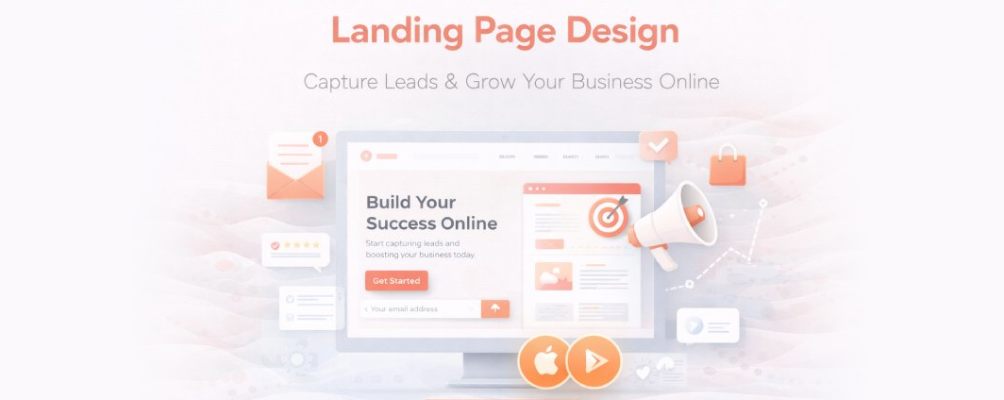
1. What Makes a Landing Page Different from a Website Page?
A landing page has a single goal — conversion. Unlike homepages or service pages, landing pages remove distractions and guide visitors toward one specific action.
Common landing page goals include:
- Lead generation (forms, demos, consultations)
- Product purchases
- App or software sign-ups
- Event registrations
- WhatsApp or phone call inquiries
In 2026, Google and Meta both reward landing pages that deliver clear intent satisfaction, fast performance, and user trust.
2. Why Landing Page Design Is Critical for Conversion Rate Optimization
Conversion Rate Optimization (CRO) is no longer optional. With rising ad costs, businesses must extract maximum value from every visitor.
A professionally designed landing page helps by:
- Reducing bounce rate
- Improving ad quality score
- Lowering cost-per-lead (CPL)
- Building trust instantly
- Guiding users with psychological triggers
Even a 1% improvement in conversion rate can significantly increase monthly revenue.
3. Clear Value Proposition Above the Fold
The first 5 seconds decide everything. Your landing page must instantly answer:
- What is this offer?
- Who is it for?
- Why should I care?
Best practices for above-the-fold sections:
- Strong headline with benefit-driven messaging
- Short supporting subheading
- Primary CTA button
- Visual or illustration explaining the offer
Avoid generic statements. Be specific, outcome-focused, and user-centric.
4. Mobile-First Design Is Mandatory in 2026
Over 70% of landing page traffic now comes from mobile devices. Google also indexes mobile versions first.
Mobile-first landing pages must:
- Load under 2.5 seconds
- Use large, readable fonts
- Have thumb-friendly CTA buttons
- Minimize form fields
- Avoid intrusive popups
A landing page that looks great on desktop but fails on mobile will lose conversions instantly.
5. Conversion-Focused CTA Placement & Design
Your Call-to-Action (CTA) is the most important element on the page. In 2026, CTAs must be:
- Action-oriented (“Get Free Demo”, “Start Trial”, “Talk to Expert”)
- Visually prominent
- Repeated strategically
- Contextual to the user journey
High-performing landing pages place CTAs:
- Above the fold
- After benefit sections
- Near testimonials
- At the bottom for decision-ready users
6. Trust Signals That Increase Conversions
Trust is a major ranking and conversion factor. Visitors must feel confident before sharing details or making payments.
Effective trust elements include:
- Client logos
- Customer testimonials
- Ratings and reviews
- Security badges
- Clear privacy policy links
Google’s EEAT guidelines strongly favor content and pages that demonstrate real-world credibility.
7. Page Speed, Core Web Vitals & SEO Optimization
Landing page performance directly affects both SEO and paid ad results.
Key optimization areas:
- Fast server response time
- Optimized images (WebP)
- Minimal scripts
- Lazy loading
- Clean HTML structure
Google rewards fast, stable, and interactive pages with better rankings and higher ad quality scores.
8. Forms That Convert (Not Scare Users Away)
Forms are often the biggest conversion blocker.
Best form practices:
- Ask only essential fields
- Use inline validation
- Clear error messages
- Strong form CTA text
- Assurance text below form
Short, simple forms convert better — especially on mobile.
9. A/B Testing & Continuous Optimization
No landing page is perfect on day one. Continuous testing is the secret to long-term success.
Elements to test:
- Headlines
- CTA text and colors
- Layouts
- Images vs videos
- Form length
Data-driven decisions consistently outperform assumptions.
Final Thoughts: Great Landing Pages Drive Business Growth
In 2026, landing page design is not just about aesthetics — it’s about psychology, performance, trust, and intent satisfaction.
Businesses that invest in high-converting landing pages see better ROI, lower ad costs, and faster growth.
Need a High-Converting Landing Page?
Let Nynedge design conversion-focused landing pages
optimized for ads, SEO, and lead generation.
Request a Free Landing Page Audit